Rights for Whales? What Tonga's Groundbreaking Law Means for the Future of Interspecies Communication
by Kate Armstrong
Executive Director, Interspecies Internet
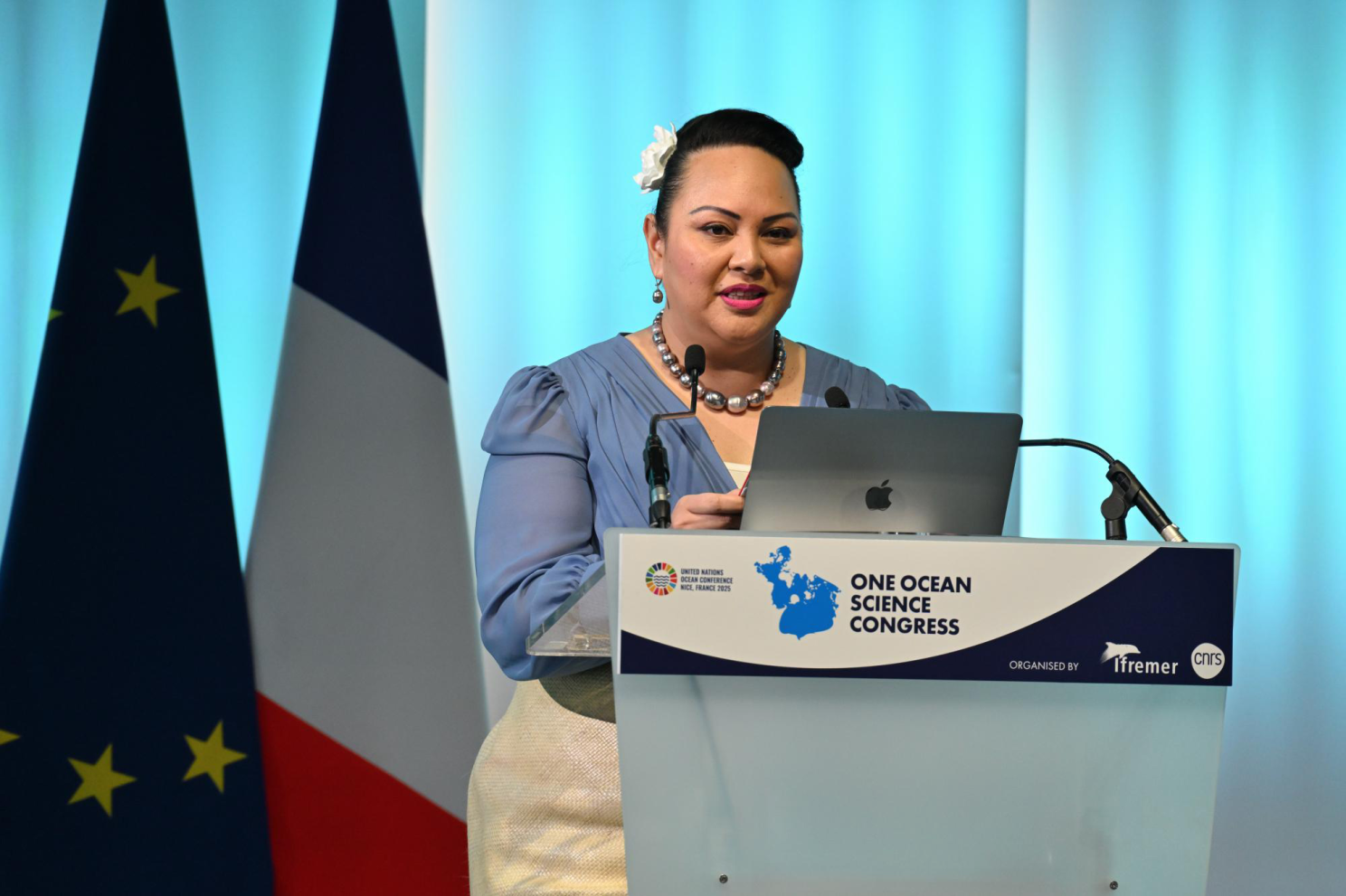
Princess Angelika Lātūfuipeka Tukuʻaho from the Kingdom of Tonga speaks at the One Ocean Science Congress on June 4 ahead of the U.N. Ocean Conference in Nice, France. Credit: Stephane Lesbats/Ifremer
The Kingdom of Tonga is on the verge of making history. Earlier this month, speaking at the United Nations Ocean Conference in Nice, France, Tongan Princess Angelika Lātūfuipeka Tukuʻaho called for the recognition of whales as legal persons, positioning Tonga to become the world's first nation to formally recognize whales' inherent rights.
This groundbreaking announcement isn't just about marine conservation; it represents a fundamental shift in how we perceive and interact with non-human intelligence. Throughout my work with Interspecies Internet, I've seen firsthand how technology is making meaningful communication across species boundaries not just possible, but practical. And how global sentiment for how we perceive non-human animals seems to be shifting.
The Legal Revolution: What Tonga's Whale Rights Act Would Mean
“The time has come to recognize whales not merely as resources but as sentient beings with inherent rights," Lātūfuipeka Tukuʻaho said. The proposed "Whales (Legal Personhood and Protection) Act 2025" would establish several unprecedented legal frameworks:
Legal personhood for whales with appointed human guardians to represent them in court
Fundamental rights, including life, migration, healthy habitat and cultural protection
Enforcement powers allowing legal proceedings to protect whale interests
Bipartisan guardianship bodies combining government officials with Indigenous and local community members
Beyond symbolic legislation, the bill would require companies to show “that their activity allows the vital cycles, processes and functions of whale populations and their habitats to continue", representing a profound shift from allowing acceptable levels of harm to preventing harm entirely.
Why This Matters to Our Work at Interspecies Internet
Since our founding in 2013, Interspecies Internet has grown into a multidisciplinary global community of 4500+ members - including leading scientists, technologists, and conservationists - gathered under the shared understanding that communication with other species requires both scientific and technological innovation, alongside understanding and recognition of non-human animal agency.
Tonga's legislative move validates what members of our community have been demonstrating through groundbreaking research. Whales possess the complex communication abilities that justify not just scientific study, but perhaps even legal recognition.
The Science of Whale Intelligence
The pace of technological advancement in decoding cetacean communication is exciting. Breakthroughs from researchers, many of whom are closely connected to the Interspecies Internet community, are revealing that whale communication systems are not only structured and contextual but deeply sophisticated, just like the whales themselves.
Project CETI have released a series of breakthroughs from their extensive research into sperm whale communications, from basic signal detection to complex, context-rich language systems. In May 2024, they proposed the first sperm whale phonetic alphabet, demonstrating structural parallels to human phonology, including vowels and combinatorial syntax-like patterns.
Whale-SETI project has observed whales creating bubble rings (perfect circular vortexes of air) during friendly encounters with humans. This playful and possibly communicative behaviour adds a new dimension to our understanding of non-vocal whale signalling, suggesting that whales may be capable of multiple modes of communication.
In a 2023 Interspecies Conversations talk, filmmaker Tom Mustill explored how emerging scientific knowledge is being made practical, impacting human action and ensuring public understanding of whale sentience.
The Business Case for Interspecies Communication
From my perspective, leading Interspecies Internet, I see Tonga's legislation as creating unprecedented opportunities across multiple sectors.
Technology Development: Science is proving that connectivity infrastructure can extend beyond human users. The market for interspecies communication technologies is emerging rapidly, with applications from marine research to environmental monitoring.
Environmental Compliance: Companies will need new frameworks for environmental impact assessments that consider non-human perspectives. Imagine environmental reviews that actually incorporate the "views" of affected whale populations, interpreted through AI systems.
Legal Innovation: The guardian representation model creates entirely new categories of legal practice. The MOTH Program is taking steps to explore how the growing number of rights-of-nature initiatives can influence global policy.
Conservation Strategy: Real-time communication with marine mammals could revolutionise conservation efforts, allowing us to understand their needs and responses to environmental changes directly.
The Global Movement We're A Part Of
Tonga's initiative reflects a broader shift we're seeing globally. Panama, Spain, Ecuador, and Bolivia have rights-of-nature laws, whilst Indigenous leaders from New Zealand and the Cook Islands have signed treaties recognising whales as legal persons.
At Interspecies Internet, we're interested in being part of, as well as convening these conversations to ensure that technologists and animal communications researchers are engaged with policymakers worldwide as such advancements are being made. An interdisciplinary approach aims to ensure that advancements in legal recognition are made simultaneously with the technological tools to make that recognition meaningful. Granting whales legal representation is all the more meaningful if we can understand what they're trying to communicate.
The Next Chapter in Human-Animal Relations
Tonga's groundbreaking legislation signals a fundamental shift in how humanity relates to other intelligent species. “How can we continue to define an ancestor or relative as mere legal property?" asks Grant Wilson of the Earth Law Centre.
From our work at Interspecies Internet, I can say with confidence that we're not just imagining a future where this question is answered; we are supporting it to be built. The technological infrastructure for meaningful interspecies communication exists. The legal frameworks are being developed. The scientific evidence for non-human intelligence is overwhelming.
The question isn't whether interspecies communication will transform our world; it is already beginning to. The question is whether we'll be ready to listen when other species finally have legal standing to speak.
As Tonga prepares to make history, we at Interspecies Internet are proud to support the technological foundation that makes this legal revolution possible. The future of human-animal relations is being written now, one conversation at a time.