Is It Time to Take the Interspecies Internet Seriously?
by Kate Armstrong
Executive Director, Interspecies Internet
At a recent high-level UN technology summit, I spoke with a prominent internet policy advisor who helps shape regulations for millions of connected devices worldwide. When I shared that my work involves internet infrastructure that includes non-human species, they responded that it sounded like science fiction.
The dismissal didn't surprise me. I get that a lot. But in this case, it highlighted something important for me. We're comfortable discussing AI consciousness, brain-computer interfaces, quantum computing and digital twins of entire cities. But the idea of extending internet connectivity to the other sentient beings already sharing our planet is still fantasy thinking.
As Executive Director of Interspecies Internet, I work at the intersection of technology, biology and ethics. Part of our mission is to bring legitimacy to the rapidly advancing field of non-human communication systems.
This isn't speculative anymore. It's happening now.
Why This Moment Matters
Vint Cerf, Chair of our Board of Trustees and co-inventor of the internet, captured how this evolution is unfolding in the 2013 TED Talk that helped launch Interspecies Internet:
“When Bob and I designed this, we thought we were building a system to connect computers. But we quickly realised it was actually a system to connect people… this network was never meant to be restricted."
As Vint foresaw in that talk, the rise of the Internet of Things now offers a mechanism for smart devices “that share our sensory environment to be part of that system.” They paved the way for us to understand what it means to connect with something other than humans.
Today, the rapid evolution of AI is once again transforming the technical layer of the internet. In the field of animal communication, this has unlocked new possibilities and is giving researchers and technologists access to interfaces and decoding tools once thought impossible.
Machine learning breakthroughs in bioacoustics, real-time behavioural analytics and pattern recognition are now turning questions of interspecies communication into engineering challenges we can actually solve.
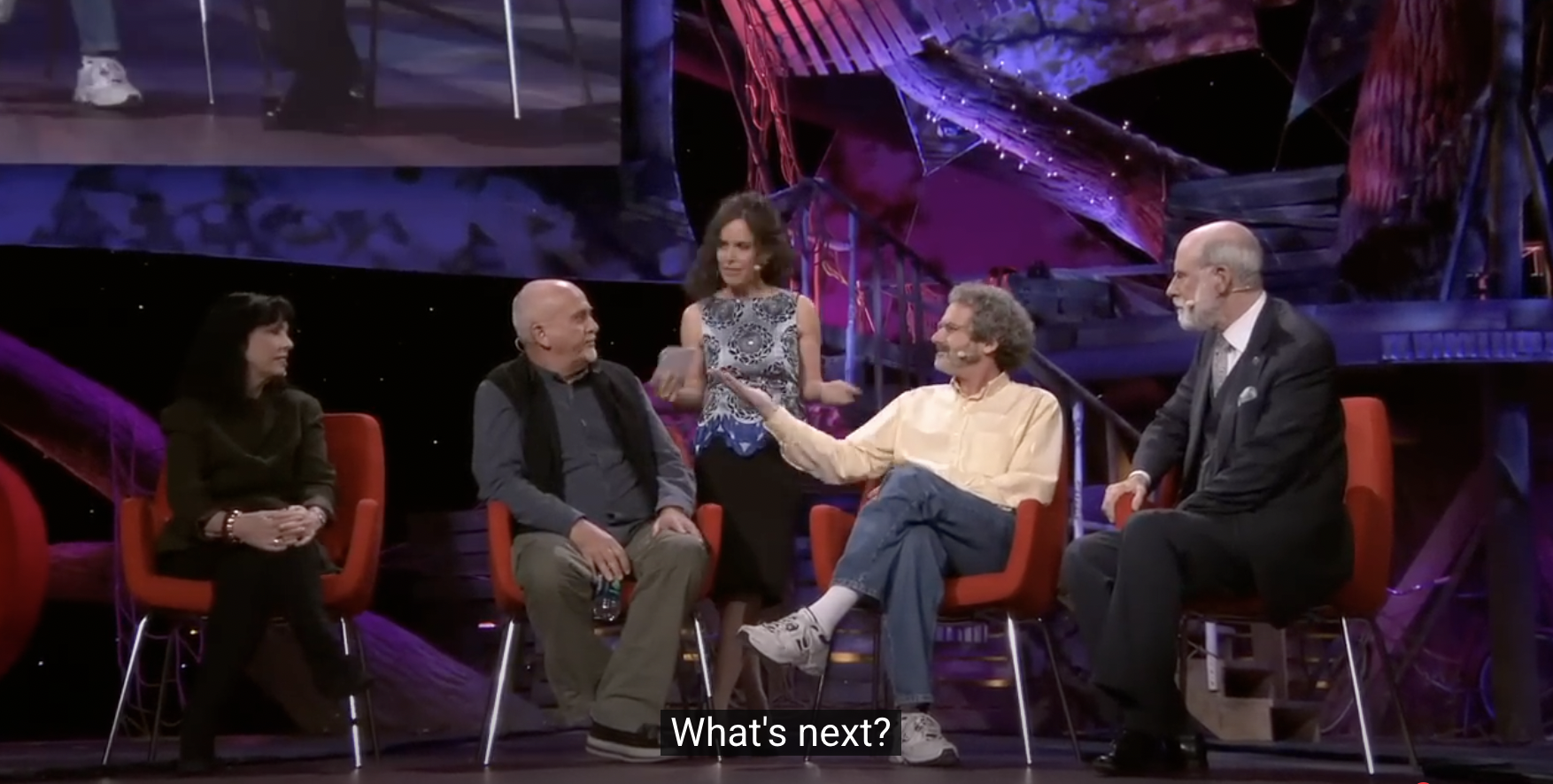
Image from the TED2013 talk that started the buzz - February 2013
The Field Is Already Here
Key developments currently being made in this emerging field are happening at the intersection of science, technology and sociocultural application.
Grizzly Systems develops real-time behaviour recognition for wildlife encounters, helping humans and animals coexist safely in shared environments.
Earth Species Project applies machine learning to decode animal vocalizations, creating open-source models that identify structure and meaning in non-human communication, with the ultimate goal of real interspecies translation for understanding.
Project CETI is using advanced AI to study sperm whale communication, uncovering the social structure and cultural complexity embedded in their vocalizations. Their work explores not only another species’ language and culture but also the ethical dimensions of engaging with non-human intelligence.
FluentPet enables dogs (and increasingly other animals) to use soundboard-style interfaces to express needs, emotions and preferences, generating behavioural data and redefining how companion animals participate in communication.
These are not coordinated efforts, but through Interspecies Internet, we aim to provide a forum to encourage interconnection and convergence of such initiatives that share the recognition that intelligence and communication extend far beyond human boundaries.
Beyond Academic Curiosity
At Interspecies Internet, our vision is that advancements in the field are led by rigorous science (the technology stands on the shoulders of scientific giants!) and that emerging discoveries are translated into meaningful, real-world impact. This work holds transformative potential across multiple sectors.
Conservation: Greater understanding of wildlife, provided by decoding signals, could reshape ecosystem management, enabling more responsive, cooperative and ethical environmental stewardship.
Technology design: Designing with non-human users in mind challenges human-centric paradigms and opens new frontiers in inclusive interface and system design.
AI and machine learning: Models derived from animal communication may inspire novel approaches to machine cognition, grounded in ecological and sensory diversity.
Policy and ethics: As non-human species increasingly become participants in digital systems, we’ll need new legal, ethical and governance frameworks to define their rights, agency and representation.
This is not just about expanding what we know. It’s about redefining how we live, design and relate across species.

Jeff Reed @GrizzlySystems
Building the Infrastructure
Interspecies Internet aims to help steward fragmented research into shared infrastructure that can meet the potential of the moment:
Ethical frameworks for interspecies technologies
Cross-disciplinary collaboration across science, tech, and conservation
Open-source tools for responsible interspecies interaction
Public engagement and institutional partnerships
We recently published our first digital publication, Animals in Translation: Imagining Criteria and Frameworks for Decoding Communication in Other Species. This landmark document represents a significant advancement in our understanding of animal communication systems and establishes new standards for the field. This reinforces a central idea that if the internet is an evolving system, it can include more forms of life, not just more data.
The Next Connection
It's natural to think of digital networks as inherently human spaces. But if communication builds relationships, and relationships build systems, then extending communication beyond our species may be essential for the challenges ahead.
The internet-connected machines. Then people. The next step might be connecting life itself.
At Interspecies Internet, we believe that shaping the future of interspecies communication requires collaboration across disciplines, sectors, and perspectives. As this field evolves, so does the need for shared infrastructure, accessible tools, and thoughtful ethical frameworks.