Effects of Symbolic Representation on Grey Parrot Cognition
with Irene Pepperberg
19 September 2026, 16:00 GMT/ 12:00 EDT/ 09:00 PDT
Effects of Symbolic Representation on Grey Parrot Cognition
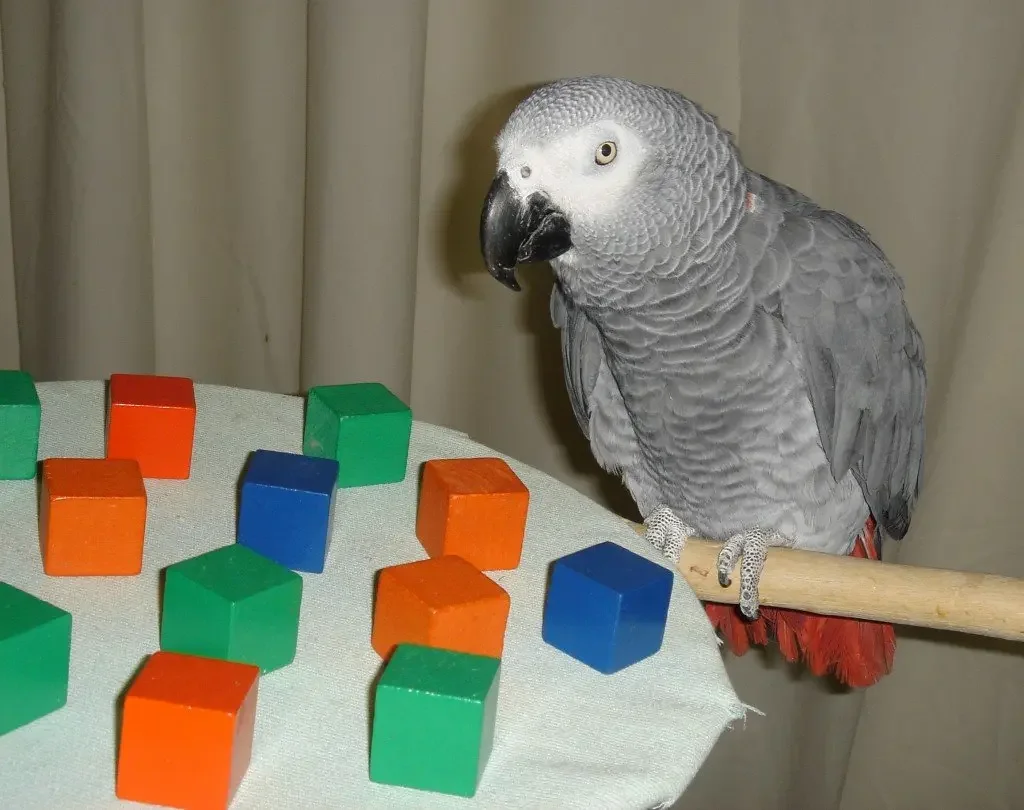
Irene Pepperberg has examined the cognitive and communicative abilities of Grey parrots (Psittacus erithacus) for almost 50 years. She has trained these birds to use English speech to identify objects, attributes, the categorical labels for these attributes, and numerical sets. They can use sentence frames (“I want X,” “Wanna go Y”) to request various items and to be placed in various locations.
Her first subject, Alex, learned concepts of same/different—not simply identity/nonidentity, but the understanding that two objects could be similar in some attributes and different in others—as well as bigger/smaller and exact numeral concepts. He questioned humans to acquire additional labels and parsed his labels to produce novel vocalizations.
More recently, work with Griffin has provided data on other forms of complex cognitive processing. Pepperberg and her research assistants have shown that only by designing tasks that cannot be solved using simple heuristics—and by collaborating with colleagues in various related fields—can researchers truly test and compare the competencies of their subjects, whether differently aged humans or nonhumans.
Examples of how such collaborative efforts have influenced this research include studies examining how Grey parrots (Psittacus erithacus) perform on “inference by exclusion” problems.
About the Speaker
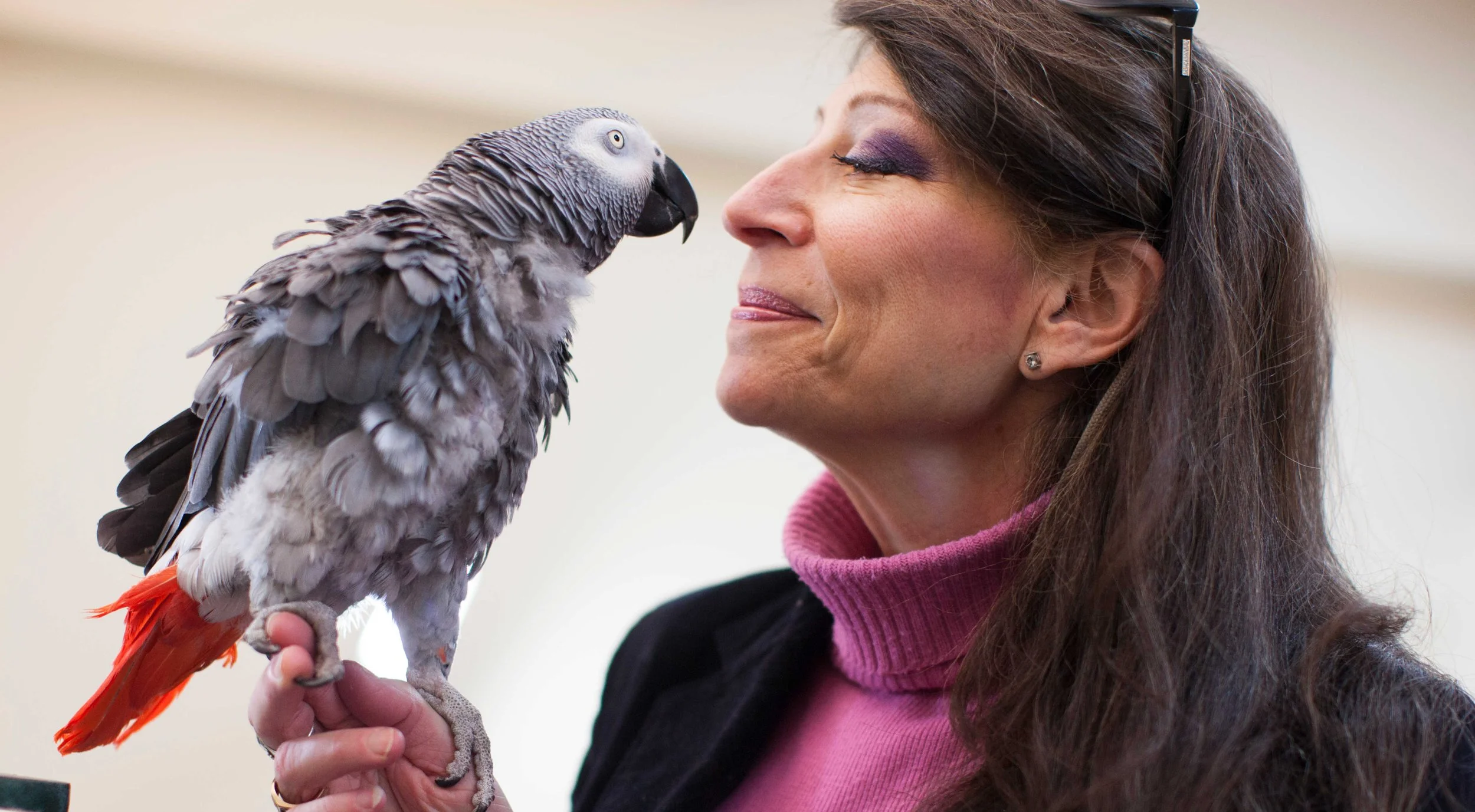
Irene & Griffin
Irene M. Pepperberg, SB (MIT), MA (Harvard), PhD (Harvard), Research Professor (Boston University), has been a visiting Assistant Professor (Northwestern), tenured Associate Professor (University of Arizona), visiting Associate Professor (MIT Media Lab), adjunct Associate Professor (Brandeis) and Research Associate (Harvard). She received John Simon Guggenheim, Selby, and Radcliffe Fellowships, is a Fellow of AAAS, APA, APS, Animal Behavior Society, American Ornithologists’ Union, Midwest and Eastern Psychological Associations. She serves on the editorial board of several journals, was an associate editor (Journal of Comparative Psychology), a board member of APA (Div 3,6) and EPA, and winner of Comparative Cognition Society, APA Div 3 and Coller-Dolittle Lifetime Achievement Awards.