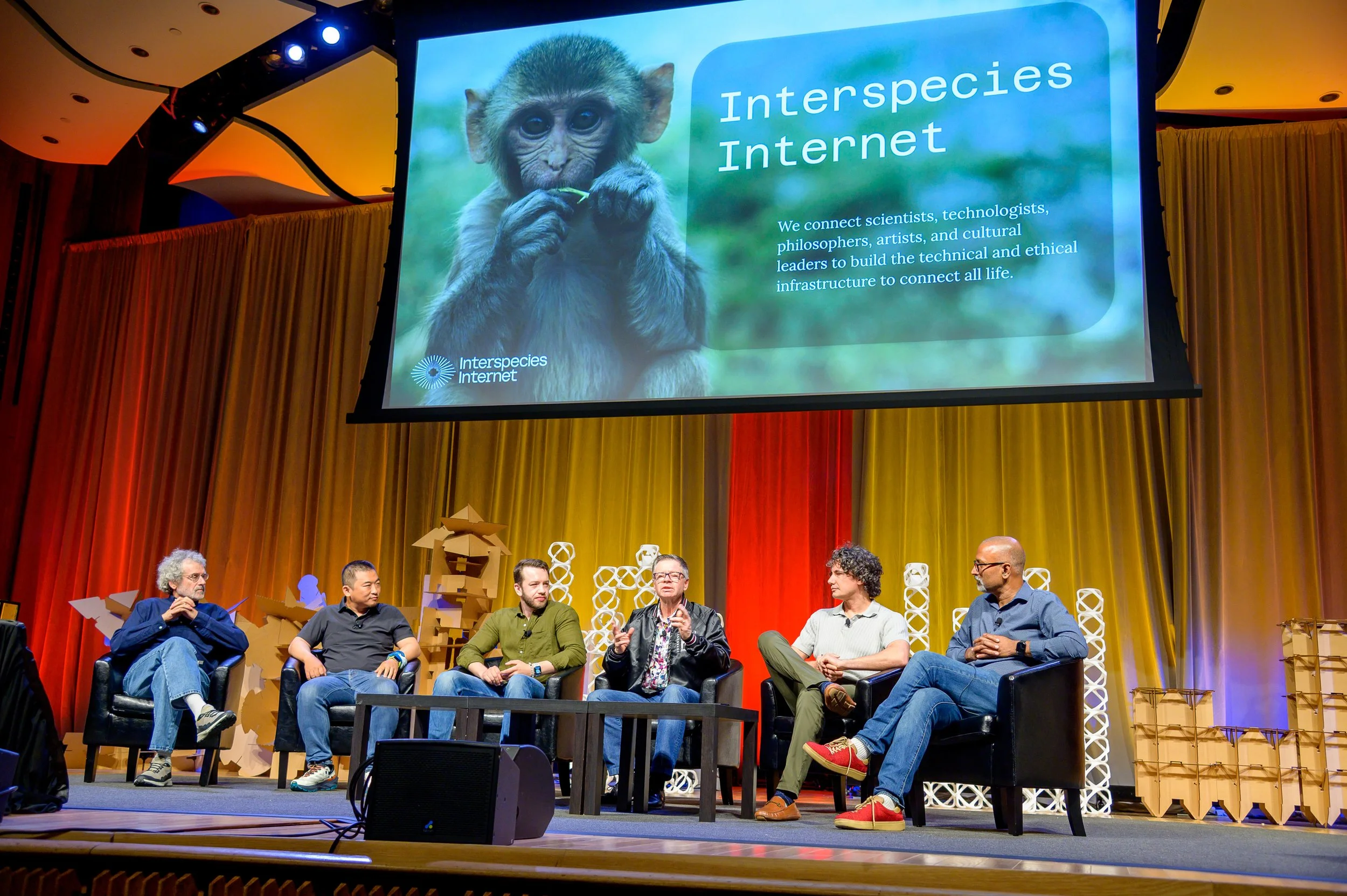
FAB26 Panel & Working Session
The Interspecies Internet Panel was held in collaboration with FabLab Foundation, Seeed Studio, FluentPet, Internet Archive, and Socratus.
FAB26: Interspecies Internet
At FAB26, we brought together researchers, designers, engineers, and practitioners working across AI, conservation, digital fabrication, and animal communication to explore the infrastructure needed to make interspecies communication possible.
The panel looked at an emerging transition in the field: from building interfaces that allow animals to signal, to using data and AI to identify representations in those signals, and ultimately toward systems that could use those representations to mediate interaction between species.
Watch the Panel ⬇️
The discussion brought together perspectives from all corners of the field: from wildlife sensing and animal collars to companion-animal interfaces, open-source hardware, and digital archives.
A recurring theme was that many of the technologies needed for this work already exist. The bigger challenge is creating the shared infrastructure, coordination, and curation needed to connect projects that have often been developed independently.
After The Panel
Following the public panel, we continued the discussion in a working session with the panelists and others at the conference who wanted to join in the conversation. If you’ve seen our Data Logger Roundtable, you already know most of the names present in the room!
Watch the Data Logger Roundtable here to learn more about where it all began.
The conversation focused on how to move from individual experiments toward shared, open tools and datasets. This included exploring modular hardware for animal data collection, a shared and searchable repository for animal communication datasets, and a competitive challenge that would connect researchers with donated engineering and prototyping support.
These efforts point toward a broader shift. The wider field is interested in moving from simply collecting and interpreting animal data toward building the infrastructure for representation-mediated interaction.
We are still far from a true interspecies internet. But the foundations are beginning to take shape, and FAB26 was an opportunity to bring some of the people building them together in conversation.
The conversation continues at New York Climate Week in September; further updates will be shared on the Slack Community and website.
Watch the full FAB26 panel here.
The Panelists
-
Prof. Neil Gershenfeld is the Director of MIT's Center for Bits and Atoms, where his unique laboratory is breaking down boundaries between the digital and physical worlds, from pioneering quantum computing to digital fabrication to the Internet of Things. He has been elected a Member of the National Academy of Engineering, a Fellow of the American Association for the Advancement of Science and of the American Physical Society, has been named one of Scientific American's 50 leaders in science and technology, as one of 40 Modern-Day Leonardos by the Museum of Science and Industry, one of Popular Mechanic's 25 Makers, has been selected as a CNN/Time/Fortune Principal Voice, and by Prospect/Foreign Policy as one of the top 100 public intellectuals. He's the founder of a global network of over 2500 fab labs in 150 countries, chairs the Fab Foundation, and leads the Fab Academy.
-
Eric Pan is the founder and CEO of Seeed Studio, a leading open hardware company that provides reference designs and supply chain services for millions of global developers since 2008. He was selected as one of Forbes China's 30 Under 30 entrepreneurs for his support of grassroots technology innovation. Currently, he focuses on developing physical AI devices that utilize real-world data and pervasive machine learning capabilities. He has also established Chaihuo maker-space in Shenzhen and has curated Maker Faire Shenzhen since 2012. He has actively contributed to the global maker movement and fablab network, making hardware accessible for everyone to build solutions for their communities.
-
Patrick Chwalek is a PhD candidate in the MIT Media Lab who specializes in designing and deploying novel, multi-modal sensing systems to generate new insights into animal and human life. While his work includes developing platforms like the AirSpecs smart-eyeglasses for human comfort research, his primary focus is on wildlife conservation. A significant portion of his work is dedicated to creating field-ready platforms that address critical bottlenecks in ecological monitoring, often in collaboration with the National Geographic Society. He architected BuzzCam, an end-to-end pipeline for on-device AI classification of endangered and invasive bee species, which was honored as a Fast Company World Changing Idea in 2025. This system was developed and deployed in Patagonia with National Geographic Explorers to create a foundational acoustic dataset for monitoring endangered pollinators. He also engineered CollarID, a versatile, low-power biologging platform designed to provide a holistic understanding of wildlife behavior beyond location-only data. He is currently deploying and validating these systems on diverse wildlife, including lions, hyenas, and wild dogs.
-
Trottier is a blend of cognitive scientist and entrepreneur. His company combines community and scientific collaboration with carefully designed communication tools to help humanity realize the potential of the animals with whom we share this planet. He started FluentPet as a PhD candidate at UC San Diego.
-
Director of the Wayback Machine at Internet Archive
An internet pioneer with extensive experience in technology and business leadership, currently leading initiatives to archive the public web and global TV news. Graham also directs projects in AI and various endeavors related to Wikipedia. -
Rajesh is the founder of Socratus, a studio for thinking through and (dis)solving wicked problems. Socratus brings citizens, scientists, artists, technologists, and changemakers into carefully designed spaces to surface collective wisdom and turn what emerges into tools, processes, and public experiments. With a background spanning academia and entrepreneurship, Rajesh works at the intersection of difficult questions and practical action: exploring what needs to be built for ideas to move beyond theory and create meaningful change. His work moves between imagining futures, building institutions, convening people, and prototyping new paths toward a more flourishing planet.